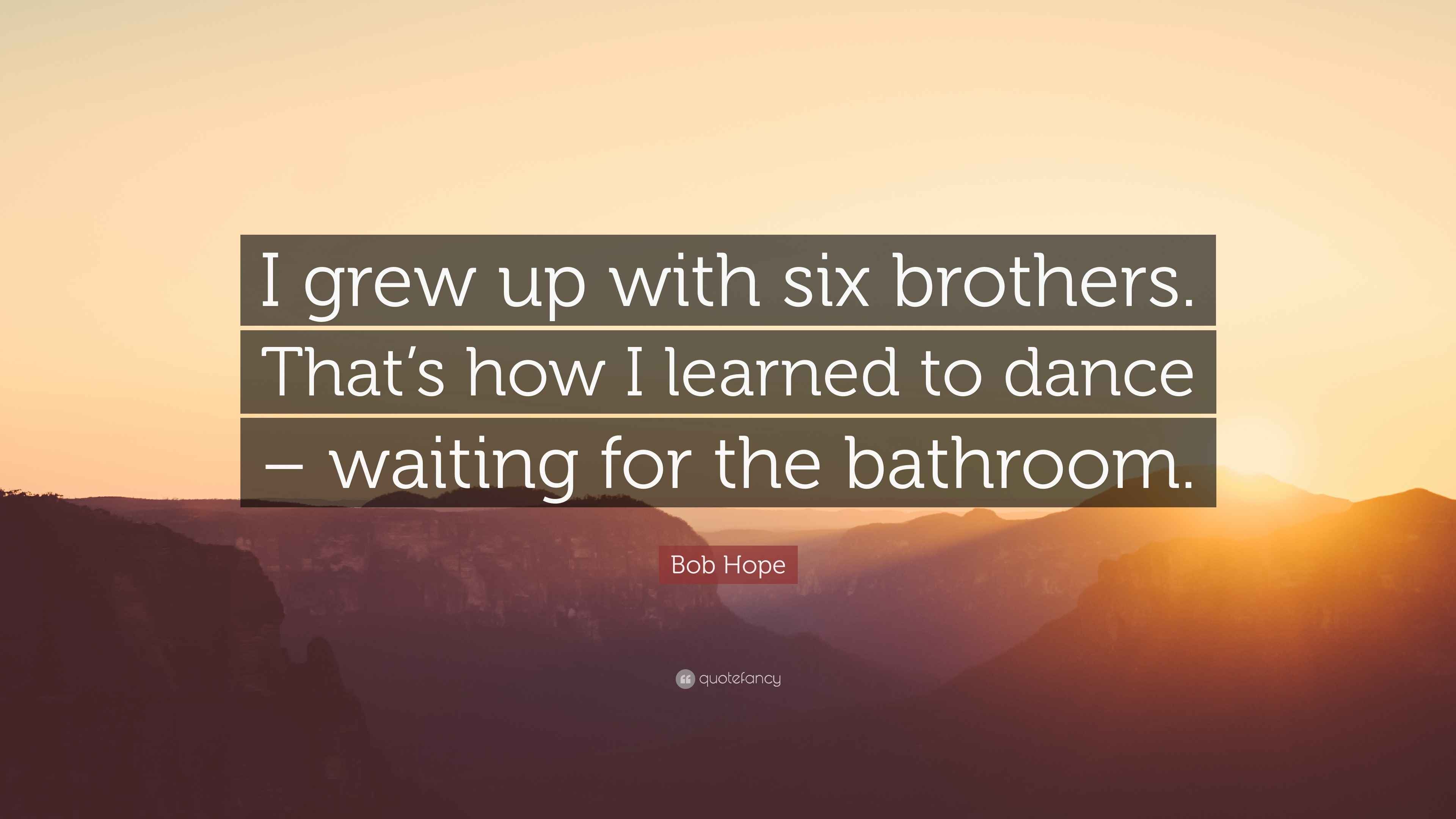
Humor isn’t just entertainment—it’s survival. Especially when you’re one of seven boys in a crowded household. When Bob Hope said, “I grew up with six brothers. That’s how I learned to dance—waiting for the bathroom,” he wasn’t just delivering a punchline. He was distilling decades of lived experience into a single, razor-sharp observation. On the surface, it’s classic Hope: quick, self-deprecating, and disarmingly funny. But beneath the laughter lies a masterclass in resilience, timing, and the unspoken rules of human connection.
That line—often shared as a “quote of the day”—resonates far beyond its comedic value. It speaks to how environment shapes character, how scarcity breeds creativity, and how the friction of daily life with siblings becomes the unlikely training ground for grace under pressure. To understand why this quote endures, we have to unpack not just the joke, but the life lessons embedded in it—on relationships, aging, and even the politics of shared space.
The Hidden Discipline Behind the Joke
Bob Hope’s bathroom quip is a textbook example of comedic misdirection. The setup—growing up with six brothers—suggests hardship, chaos, or competition. The payoff—learning to dance while waiting—transforms that struggle into artistry. But the real lesson isn’t about dance. It’s about adaptation.
In a home with limited resources—whether it’s hot water, food, or personal space—survival depends on timing, awareness, and patience. You learn to anticipate others’ moves, to step aside before conflict arises, to wait your turn without resentment. These aren’t just household skills. They’re the foundation of healthy relationships.
Consider the modern workplace: a junior employee who learns to read the room, time their input, and avoid stepping on toes is often more effective than one with superior technical skills but poor emotional intelligence. Hope’s “dancing” is metaphorical—yet entirely practical. It’s the ability to move fluidly through human systems without causing disruption.
Real-world example: A manager who waits for the right moment to voice concerns in a team meeting—instead of interrupting—demonstrates the same kind of situational awareness Hope developed in that crowded family bathroom.
Sibling Rivalry as Relationship Training
Growing up with six brothers didn’t just teach Bob Hope timing—it taught him negotiation, conflict resolution, and the fine art of compromise. In large families, every interaction is a micro-negotiation: who gets the last piece of pie, who controls the TV remote, who takes out the trash.
These daily skirmishes are early rehearsals for adult relationships. Whether it’s a romantic partnership, a business collaboration, or a friendship, the ability to manage tension without escalation is crucial. Hope’s humor often played on power dynamics—between husbands and wives, generals and privates, audiences and performers. But the roots of that insight were laid at home.

Common mistake: Many people enter relationships expecting harmony. They’re unprepared for conflict and interpret disagreement as failure. But Hope’s life suggests a different model: friction isn’t a bug—it’s a feature. It’s how we learn to adjust, to yield, to lead when needed and follow when appropriate.
Think of it like jazz improvisation. Each musician listens, responds, and builds on the others’ input. Nobody solo the entire time. Hope’s childhood was a kind of improvisational training—where the bathroom line was his first ensemble.
Aging with Humor: The Bob Hope Way
Hope lived to be 100. His longevity wasn’t just biological—it was behavioral. He aged not by resisting time, but by mocking it. His later routines were full of jokes about memory loss, retirement homes, and the indignities of growing old. But the subtext was clear: laughter is armor.
When he joked about learning to dance in a crowded household, he wasn’t just reminiscing—he was modeling a mindset. The ability to reframe hardship as humor is a powerful tool for emotional resilience. And as we age, that skill becomes essential.
Practical use case: An older adult dealing with reduced mobility might feel frustration or shame. But by adopting a Hope-like perspective—“I’m not slow, I’m on energy-saving mode”—they reclaim agency. Humor becomes a coping mechanism, not an escape.
Hope’s quote about the bathroom isn’t just about youth. It’s a reminder that the habits formed early—patience, observation, the ability to laugh at inconvenience—compound over decades. They become the difference between aging with bitterness or with grace.
The Politics of Shared Space
Hope’s line also carries a subtle political dimension—one that feels increasingly relevant in today’s polarized world. Living with six brothers required constant negotiation of shared resources. There was no room for absolutism. Compromise wasn’t optional; it was survival.
In that sense, his household was a microcosm of civil society. You couldn’t dominate. You couldn’t refuse to participate. You had to develop systems—formal or informal—for fairness, turn-taking, and conflict resolution.
Modern parallel: Consider urban living. In dense cities, people share elevators, sidewalks, parking spots. The etiquette of shared space—holding doors, apologizing for bumping, taking turns—isn’t trivial. It’s the glue of coexistence. Hope’s “dance” is a metaphor for that unspoken social choreography.
Where many see chaos in crowded environments, Hope saw rhythm. Where others might resent waiting, he saw opportunity—for observation, for humor, for connection.
Why This Quote Still Resonates
Not all quotes age well. Some feel dated, overly sentimental, or disconnected from modern life. But Hope’s bathroom line endures because it’s rooted in universal truths:
- Scarcity breeds creativity
- Conflict is inevitable, but not destructive
- Humor is a survival tool
- The mundane can be profound
It’s also timeless in its delivery. The joke works in 1945, in 1985, and today. It doesn’t rely on current events or cultural references. It draws from fundamental human experience.
Limitation to note: Not everyone grew up in a large family. Some may feel excluded by the specificity of “six brothers.” But the principle transcends biology. Roommates, coworkers, even online communities can create the same conditions—crowding, competition, the need for timing. The lesson isn’t about siblings. It’s about interdependence.
The Art of Timing: Beyond the Bathroom
Hope was a master of comedic timing—both on stage and in life. His famous USO tours during wartime weren’t just about entertainment; they were about delivery. He knew when to crack a joke, when to pause, when to let silence speak.
That same precision applied at home. Waiting for the bathroom wasn’t passive. It was active observation. He wasn’t just killing time—he was studying behavior, refining his sense of rhythm.
Workflow tip: In your own life, treat delays as data. When you’re stuck in traffic, in line, or on hold, don’t just scroll. Notice patterns. Listen to conversations. Observe body language. Like Hope, use the wait to sharpen your awareness.
This mindset turns frustration into opportunity. It’s the difference between wasting time and training.
Bob Hope’s Legacy: Humor as Wisdom
Too often, we separate comedy from wisdom. We see comedians as entertainers, not philosophers. But Hope’s best lines—like this one—are philosophical statements disguised as jokes.
“I grew up with six brothers. That’s how I learned to dance—waiting for the bathroom” isn’t just funny. It’s a lesson in humility, patience, and the quiet dignity of enduring daily life with grace. It teaches us that wisdom doesn’t always come from meditation or mentorship. Sometimes, it comes from standing in line, watching your brothers, and realizing that life, like dance, is about rhythm, not control.
Practical Takeaways from Hope’s Quote
- Reframe waiting as preparation, not wasted time.
- Use friction in relationships as a chance to practice empathy.
- Laugh at inconvenience—it reduces its power over you.
- Observe more, react less.
- Find rhythm in routine.
Humor isn’t the opposite of seriousness. In Hope’s world, it’s its most honest expression.
FAQ
What did Bob Hope mean by “I learned to dance waiting for the bathroom”? He meant that growing up in a crowded household taught him timing, patience, and how to navigate shared spaces—skills that mirror the grace and rhythm of dance.
How many brothers did Bob Hope actually have? Bob Hope had five brothers—Leslie, Lindsay, Ralph, Roy, and William. The “six brothers” line was a comedic exaggeration, common in stand-up.
Why is this Bob Hope quote so popular? It’s relatable, funny, and layered. It turns a mundane family experience into a metaphor for resilience, timing, and emotional intelligence.
What life lessons can we learn from Bob Hope’s humor? That laughter is a tool for coping, that observation builds wisdom, and that everyday struggles can shape character—if we reframe them.
Did Bob Hope often use family in his comedy? Yes. His routines frequently drew on family dynamics, marriage, and generational differences, using humor to explore deeper truths.
How can this quote apply to modern life? In workplaces, relationships, and crowded cities, the ability to wait, adapt, and respond with humor is more valuable than ever.
Is the quote about dancing literal or metaphorical? It’s metaphorical. Hope wasn’t literally dancing—he was using humor to describe the skill of moving gracefully through life’s bottlenecks.
FAQ
What should you look for in Bob Hope's Quote on Brothers and Life Lessons? Focus on relevance, practical value, and how well the solution matches real user intent.
Is Bob Hope's Quote on Brothers and Life Lessons suitable for beginners? That depends on the workflow, but a clear step-by-step approach usually makes it easier to start.
How do you compare options around Bob Hope's Quote on Brothers and Life Lessons? Compare features, trust signals, limitations, pricing, and ease of implementation.
What mistakes should you avoid? Avoid generic choices, weak validation, and decisions based only on marketing claims.
What is the next best step? Shortlist the most relevant options, validate them quickly, and refine from real-world results.